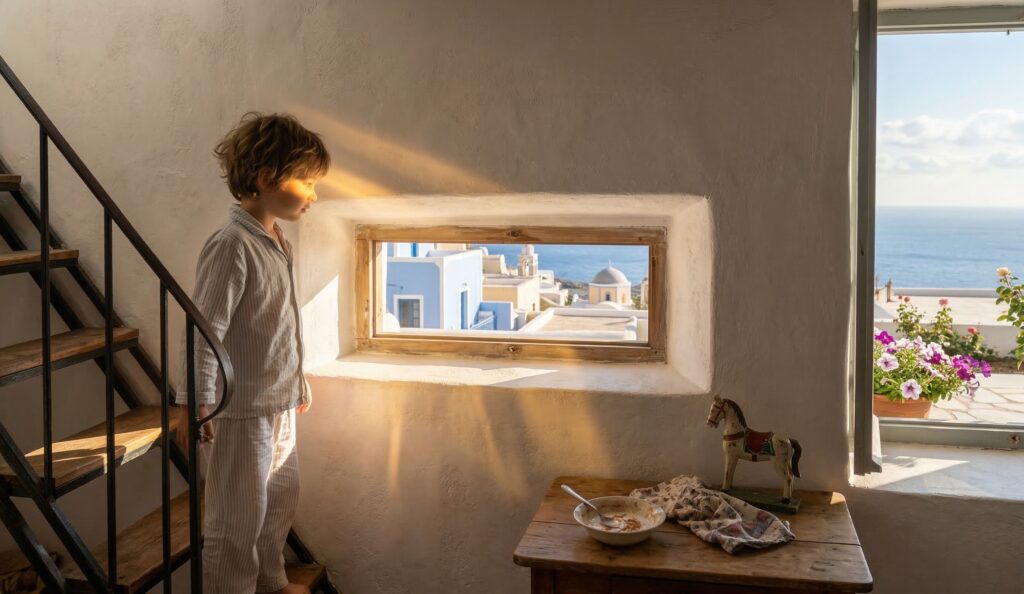
"Memories" The chronicle of a moment
“So imagine it’s Sunday morning and you’ve just woken up. The sun has peeked out of the window, you open it and feel the morning breeze blowing through the long window opening, and the sunbeams swirling restfully warming your face. You hear Mama’s pots and pans working and before you are well awake you descend the iron staircase with its wooden treads kept warm from the night, you pass through the hallway greeting the petunias and rose bushes that offer you their vibrant color that pierces the endless glass that separates you from the morning dew.
At the far end behind a round opening is the kitchen. You enter, already seeing the cream from the milk pudding is ready and you dip your spoon into it, thus devouring this warm pleasure and mischief. The kitchen counter is long, and comfortable and the tired dirty utensils take their place in the sink. After finishing this pleasure you take your breakfast tray and go straight out to the terrace. You’re one of the lucky ones whose house overlooks the sea. You set the tray down on the little table by the fountain and stretch your legs on the opposite chair, gazing out over the endless blue that the absence of an obstacle offers you.
Slowly, noon arrives and dinner is ready and the family is gathered around the table that grandfather had given us. It is big and oaky and even though it is 80 years old it smells of mature wood. The signs of wear and tear on it remind me of every feast and every damage that has occurred in the endless and noisy dining rooms it has known. It is placed under a patio that lets in plenty of light but not the vibrant midday sun rays. It’s relaxing here and I even like to read and do my homework. Hours endlessly pass sometimes with fatigue sometimes with joy and sometimes with mixed emotions. But when I’m done, I rush to the fridge to munch on some treats that mom has prepared.
In the afternoon, Mom’s friends gather to have coffee. They go out into the garden and decorate the marble table with different delicacies. He had brought it piece by piece. He put it together slowly and carefully with his glues, and each time each piece fell into place he stopped, proudly taking a sip of the coffee we had offered him. Greek medium with a little. So he drank it and his mom always made a variety of cookies to share with me. I loved watching it being made, and I still remember him at the table drinking his coffee. So now the table still hosts coffee and conversation and even beer and junk food and ouzo appetizers. All of our friends have passed by this table.
But when it’s soupy, there’s nothing better than the couch in the living room. It has a huge glass window in front of it and lets in the sweet red light that enchants and brings your imagination to life. Clouds in the sky ,a pile in various shapes. As the sunbeams bounce between them they change color fading away far away on the horizon. Somewhere I like to play hide and seek with the sun in the southwest window. It is oblong, a slit so small and I still don’t understand why they made it, but I like to hide and make up stories with my warhorse. After the sun goes down there is still twilight for a while, the only thing that still lights up the porch. It is beautiful and sweet and I love to walk barefoot on the concrete patio we have paved. It is smooth to the touch and gives you the feeling of that summer we went to Santorini when all the houses had cement on their verandas with ash from the volcano and grated tile (at least that’s what a local handyman I met told me ). The whole volcano beneath my feet and next to me a hanging lamp on the edge of the balcony hovering and swaying to the dictates of the evening breeze.
Sunday night we usually go to friends’ houses and quickly get ready. Everyone opens their closets to choose what to wear. Mom always sees her dress in the full-length mirror that we put in the hallway next to the glass bathroom door. I still get confused about which glass to open. After we all get ready and get down to the entrance canopy with the endless plants that greet every guest that comes to our house, we leave for my favorite walk. I love the car ride. I sit at the window and gaze out at the buildings, roads, bridges, and all these wondrous structures, and watch others like us going out and make their way through, between, behind, and beyond what surrounds them. “
This was a short story through the eyes of a child who watches and recognizes the space he moves through. He sees in every corner of the built space a little story unfolding and leaving him with that memory that the aroma of the freshly baked cream of milk bourguignon sprinkled with cinnamon leaves.
Yes, architecture has something of cinnamon in our memory.
If we take a look at the elements that structure architecture, as far as buildings are concerned and start from the time when man started to structure his own artificial space, we could say that his basic tools for structuring space are the horizontal and vertical elements.
The primary horizontal element is the earth. Given and mother of all structures and creatures that are hosted on our planet.
The first artificial horizontal element is the roof. The first artificial cover offered protection from rain and snow. Constructed sometimes from reeds, leaves, straw, wood, and other materials that can be spread out to provide cover for humans.
With the development of his knowledge and technology, he was able to harness the forces of nature to join various materials with mortar and constructed the slab, the second artificial horizontal element, with which man structures space.
The first vertical element constructed by man is the wall. An element that protects us from the weather and gives us the ability to control the environment we live in. To define our way of living and organize space. It is made sometimes of bricks, straw, mudstones, and wood…..
The column, the second fundamental vertical element, was originally wooden and mainly served as the central support of the roof. With the development of carving technology, the column became stone and could support larger loads. Its newer version of composite concrete elements, a composition of cement stones and water, allows for multi-functional structures in both shape and load-bearing capacity.
These in short are the four basic artificial elements with which we control build and structure our artificial space. Four walls and a roof make up our basic building unit.
The room.
A cluster of rooms with a plot and differentiation of their use makes up our unit of urban habitation. What we call a building.
But man is a being that lives and feeds on his impulses. We have five basic senses, smell, taste, touch, hearing, and sight. With these senses we understand and interact with our environment, natural and artificial, and we receive our experiences and form memories. We, therefore, have the need and desire to communicate with the environment.
That is why man has cut a hole in the wall so that he can communicate with his natural environment protected from the elements. What we call a window. At the very moment he opened the window he created a frame. In that gap, a part of the natural world stands out from the whole. You thus create a painting that has been chosen to be viewed from the inner artificial world.
Through this interface moments and experiences are captured. Every time we gaze through this void, memories of the moment are engraved within us. The passing light, the weather conditions, the relative temperature, the inside versus the outside, the season, the time and our own emotional charge seek through this void a correspondence with the outside world. So in architecture, the void, that is the lack of the complete, creates conditions for moments to be captured. The sum of these moments produces memories. So if instead of a window we understand a void, then every time we put one complete element next to another and every time a wall comes close to another but never joins then we have the condition of producing moments.
The complete and the gaps besides their functional property can be self-contained and can also produce, as unchanging entities, moments. Their dimensions their rhythm their materials and their placement in space can harness the light that passes through them and create an impression that can seal a moment.
The contact of the vacuum with the environment feeds the interior space with light. The quality of the light depends on the time of day, the season, and the weather conditions gives the space a corresponding tone. The red of the sunset, the turquoise of the morning, and the clear light of a sunny day color and fill the whole interior space with emotions.
Depending on the dimensions of the void, the light can take shape. It can become a luminous slit that seems to hold the full surrounding light at a distance, or a breeze that is allowed to gently and warmly pour through a wide opening.
Thus by shaping the gaps you also produce a story. The one that will be created by the impression of the viewer’s world through the gaze of the void. We could say that in essence, the voids function as sensory organs of a living organism in which we inhabit inside. Every corner of it, depending on its mode and size, can produce experiences. So every time we travel through a building and depending on the frame in front of us, we hold memories. The spaces of a structured space can therefore be said to be our eyes on the world.
Having at a specific time a specific frame with a specific lighting that penetrates into the space along with the specific weather conditions and with a specific emotional charge, you produce a moment that remains indelibly written in our memory.
And this one definitely has something of cinnamon in it.
2016 Yannis Millas